
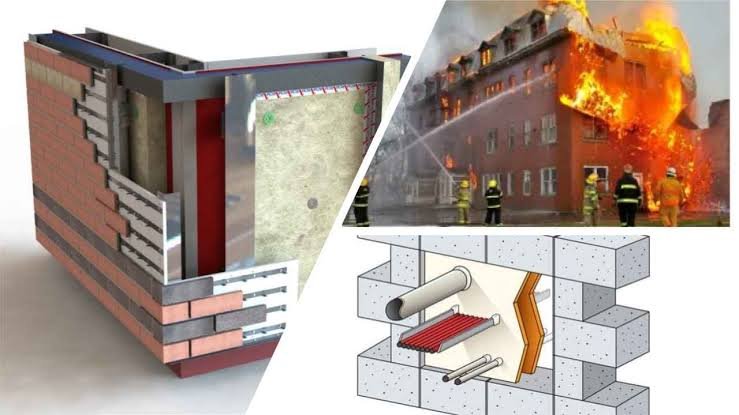
Fire safety can sometimes seem complicated because it involves building materials, alarms, extinguishers, emergency exits, electrical systems, and many technical standards. One important part of this wider subject is fire resistant materials.
In simple terms, fire resistant materials are products or building assemblies designed to withstand fire exposure for a specified period, slow the spread of flames and heat, or help protect important parts of a building. They can contribute to safer evacuation and give emergency responders additional time to act.
However, fire resistant does not mean completely immune to fire. The performance of a product depends on its design, application, installation, thickness, surrounding materials, and the conditions under which it has been tested.
For buildings in Pakistan, material selection should be considered alongside applicable building regulations. The Pakistan Engineering Council lists the Building Code of Pakistan – Fire Safety Provisions 2016 among the country’s building codes and standards. The code covers fire prevention, life safety, building construction, fire protection systems, and other measures intended to reduce danger from fire.
This guide explains fire resistant materials in plain English and discusses how they fit into an overall fire safety strategy.
What Are Fire Resistant Materials?
Fire resistant materials are materials or complete construction assemblies designed to provide a defined level of resistance when exposed to fire.
They may help:
- Slow the spread of flames
- Reduce heat transfer
- Protect structural components
- Separate different areas of a building
- Protect escape routes
- Reduce the movement of fire and smoke
- Maintain the performance of important building elements for a specified period
Examples can include specially designed walls, floors, ceilings, doors, glazing, insulation, firestop products, protective coatings, and other construction systems.
The important word is specified. A product is not automatically suitable for every fire protection application simply because its packaging describes it as fire resistant.
Fire Resistant Does Not Mean Fireproof
The terms “fire resistant” and “fireproof” are sometimes used casually, but they should not be treated as meaning that a material can withstand any fire indefinitely.
Fire-resistance performance is normally determined under particular testing conditions.
For example, a building element may be designed and tested to maintain its required performance for a certain number of minutes or hours.
The required level depends on factors such as:
- Building type
- Occupancy
- Construction type
- Building height
- Location of the element
- Fire hazards
- Applicable building requirements
The Building Code of Pakistan contains provisions dealing with fire-resistance ratings and construction features. More recent Building Code of Pakistan material also addresses fire-resistant coatings and materials used to protect penetrations and joints in fire-resistance-rated assemblies.
Why Fire Resistance Is Important
When a fire starts, the objective is not only to extinguish it. Another important objective is to prevent or slow its spread.
Fire-resistant construction can help create separation between areas of a building.
For example, a properly designed fire-rated wall may separate one area from another, while a protected stair enclosure can help maintain a safer evacuation route.
This concept is often called passive fire protection.
Passive protection differs from active systems such as alarms and suppression equipment.
A building may therefore use several layers of protection:
- Fire-resistant construction
- Fire detection
- Fire alarm notification
- Fire suppression
- Emergency exits
- Emergency lighting
- Firefighting equipment
- Evacuation procedures
- Training and maintenance
Each layer serves a different purpose.
Common Fire Resistant Materials
There is no single material that is appropriate for every building application. Different products are designed for different situations.
1. Concrete
Concrete is commonly used in structural construction and can provide substantial resistance to fire.
Its performance depends on factors such as:
- Thickness
- Composition
- Reinforcement
- Structural design
- Moisture
- Fire exposure
Simply knowing that something is made from concrete does not automatically establish its fire-resistance rating.
2. Gypsum-Based Boards
Specially manufactured gypsum boards are frequently used in fire-rated wall and ceiling assemblies.
Some products contain additives or reinforcement intended to improve their behavior during fire exposure.
However, the complete system matters.
The performance can depend on:
- Number of board layers
- Board thickness
- Framing
- Insulation
- Fasteners
- Joint treatment
- Installation method
Changing one component can change the performance of the entire assembly.
3. Fire-Rated Glass
Fire-rated glass can be used where designers need visibility or natural light while maintaining a required level of fire protection.
It may be used in:
- Doors
- Internal windows
- Partitions
- Protected corridors
- Stair enclosures
Fire-rated glazing needs to be installed with compatible frames and other components appropriate to the tested system.
4. Fire-Rated Doors
A fire-rated door is more than simply a thick or metal door.
A complete door assembly may include:
- Door leaf
- Frame
- Hinges
- Latching hardware
- Door closer
- Seals
- Compatible glazing
The components need to work together as an appropriate assembly.
A damaged or incorrectly modified fire door may not provide the intended performance.
5. Firestop Materials
Modern buildings contain many pipes, cables, ducts, and other services.
These services often pass through fire-rated walls and floors.
Firestop systems are designed to protect these openings and help maintain the intended fire-resistance performance of the barrier.
Products can include:
- Firestop sealants
- Mortars
- Collars
- Wrap systems
- Boards
- Other tested penetration systems
The correct solution depends on the penetration and the construction around it.
6. Fire-Resistant Insulation
Some insulation products are designed to provide thermal protection and may form part of fire-rated construction.
The appropriate product depends on the application and required performance.
Insulation should therefore be selected according to the complete building assembly rather than simply choosing a product based on its description.
7. Fire-Resistant Coatings
Special coatings can provide additional fire protection for certain substrates.
Some coatings are designed for structural steel and can expand or otherwise respond to heat to provide insulation during a fire.
The Building Code of Pakistan material specifically references sprayed fire-resistant materials and intumescent and mastic fire-resistant coatings when determined through applicable fire-resistance testing and installed according to the relevant requirements.
Coatings must be applied according to the manufacturer’s specifications, including requirements concerning preparation, thickness, environmental conditions, and compatible systems.
Understanding Fire-Resistance Ratings
A fire-resistance rating generally indicates how long a tested building element can meet defined performance criteria during a standardized fire exposure.
You may see ratings expressed in:
- Minutes
- Hours
For example, a design may require an assembly to achieve a particular rating for a specified period.
The rating is not simply a statement about how long the raw material can survive.
It can apply to a complete tested assembly.
This distinction is important because a product that performs well by itself may not produce the same result when installed differently.
Material vs. Assembly
This is one of the most important concepts to understand.
Imagine a fire-rated wall.
Its performance may depend on:
- Board type
- Number of layers
- Framing
- Insulation
- Fasteners
- Joint treatment
- Wall thickness
- Penetrations
- Installation method
If one component is changed, the performance of the complete wall may also change.
Therefore, buyers should look for documentation describing the tested or approved configuration rather than assuming that any combination of fire-resistant products will produce the same result.
Where Are Fire Resistant Materials Used?
Fire-resistant materials can be incorporated into many parts of a building.
Walls
Fire-rated walls can help separate areas and limit fire movement.
They may be used for compartmentation, protected corridors, or other locations where separation is required.
Floors
Fire-resistant floor assemblies can help reduce fire spread between levels.
This can be particularly important in multistorey buildings.
Ceilings
Some ceiling assemblies form part of a fire-resistance-rated construction system.
The complete assembly should be considered when selecting materials.
Stair Enclosures
Protected stairways can be an important part of a building’s means of egress.
The walls, doors, penetrations, and other components surrounding the stairway may need to meet specified fire-safety requirements.
Service Openings
Cables, pipes, and other services can create openings in fire-rated barriers.
Appropriate firestop systems can help maintain the intended separation.
Choosing the Right Fire Resistant Material
The right question is not simply:
“Which material is the most fire resistant?”
Instead, ask:
“Which tested and suitable system is appropriate for this particular application?”
Before purchasing, consider:
- Where will it be installed?
- What type of building is involved?
- What fire-resistance rating is required?
- What material will it connect to?
- Is the product tested for this application?
- Is installation documentation available?
- Are there limitations on its use?
- Does it require specialist installation?
- How will it be maintained?
This approach is more useful than choosing a product based solely on its marketing description.
Read Technical Documentation
When purchasing fire protection products, documentation is important.
Depending on the product, relevant documents may include:
- Technical data sheets
- Installation instructions
- Test reports
- Certification information
- Fire-resistance ratings
- Application limitations
- Maintenance requirements
- Manufacturer specifications
A supplier should be able to explain what the product is designed to do and where it can appropriately be used.
Avoid relying exclusively on broad claims such as “100% fireproof” without checking the technical information behind the claim.
Correct Installation Matters
Even a suitable product can fail to provide its intended performance when it is installed incorrectly.
Common problems can include:
- Incorrect thickness
- Wrong fasteners
- Poor joints
- Missing insulation
- Incorrect framing
- Unprotected cable openings
- Improper door installation
- Incorrect coating application
- Unauthorized modifications
Installation should follow the relevant manufacturer’s instructions and the requirements of the applicable tested system.
For complex or safety-critical applications, qualified professionals should be involved.
Protecting Penetrations
A fire-rated wall or floor can be compromised when cables and pipes pass through it without suitable protection.
This is why penetration protection is an important part of passive fire protection.
For example, an electrical cable passing through a fire-rated wall creates an opening. If that opening is not appropriately protected, it can become a pathway for heat, flames, or smoke.
The correct firestop system depends on factors such as:
- Type of service
- Opening size
- Wall or floor construction
- Materials involved
- Required fire rating
The Building Code of Pakistan material specifically identifies materials used to protect penetrations and joints in fire-resistance-rated assemblies.
Fire Doors Need Regular Inspection
Fire doors are frequently used in buildings because they can combine everyday access with fire separation.
However, they are mechanical assemblies and require attention.
A basic inspection can consider:
- Door condition
- Frame condition
- Hinges
- Closing mechanism
- Latching
- Seals
- Glazing
- Damage
- Obstructions
Doors should not be modified or held open in a way that defeats their intended fire-safety function.
Fire Resistant Materials and Fire Alarm Systems
Passive fire protection and fire alarm systems perform different jobs.
Fire-resistant walls, doors, floors, coatings, and penetration systems are intended to help limit fire and heat movement.
A fire alarm system is intended to detect or receive indications of fire and warn occupants.
A fire alarm system in Pakistan may include components such as:
- Smoke detectors
- Heat detectors
- Manual call points
- Fire alarm control panels
- Sounders
- Visual notification devices
- Backup power
- Other system components
Flame Defender describes its Pakistan fire alarm installation service as covering conventional and addressable systems, including smoke detectors, heat sensors, and control panels.
The two approaches should work together rather than being viewed as alternatives.
For example, fire-resistant construction can help slow fire spread while the alarm system provides warning that allows occupants to begin evacuation.
Fire Resistant Materials and Fire Suppression
Suppression systems are another part of an integrated fire safety approach.
Depending on the hazard, buildings may use systems such as:
- Water-based suppression
- Water mist
- Dry powder
- Clean-agent systems
- Kitchen suppression systems
The appropriate system depends on the hazard and the protected environment.
Flame Defender describes suppression solutions for areas including server rooms, data facilities, industrial kitchens, manufacturing sites, and other specialized environments.
A suppression system should not be selected simply because it is widely used. The system should be appropriate for the specific fire risk.
Fire Resistant Materials in Homes
Residential buildings can benefit from appropriate fire-resistant construction, particularly around areas where fire separation may be important.
Potential considerations include:
- Kitchen areas
- Electrical rooms
- Garages
- Utility spaces
- Stairways
- Service penetrations
- Doors between different areas
However, residential fire safety also depends heavily on detection, evacuation planning, electrical safety, and suitable firefighting equipment.
Materials alone cannot eliminate fire risk.
Fire Resistant Materials in Commercial Buildings
Commercial properties often have larger numbers of occupants and more complicated layouts.
Offices, hotels, shopping centres, hospitals, and educational buildings may contain:
- Multiple floors
- Kitchens
- Electrical rooms
- Storage spaces
- Service shafts
- Large numbers of occupants
Fire-resistant construction can support compartmentation and protected escape routes where required.
The appropriate design depends on the building’s use and applicable requirements.
Fire Resistant Materials in Industrial Buildings
Industrial environments can have more complex fire hazards.
These may include:
- Manufacturing equipment
- Combustible materials
- Flammable liquids
- Electrical machinery
- Storage areas
- High-temperature processes
- Fuel systems
Material selection should therefore be based on an appropriate fire-risk assessment.
A product suitable for an ordinary office may not be appropriate for an industrial process area.
Common Mistakes When Buying Fire Resistant Materials
Mistake 1: Choosing Only by Price
A low purchase price does not necessarily represent the most appropriate solution.
Installation, maintenance, compatibility, and expected service life should also be considered.
Mistake 2: Believing Marketing Claims
Terms such as “fireproof” can be misleading when there is no supporting technical information.
Always check the documentation.
Mistake 3: Ignoring the Complete Assembly
The performance of one component does not necessarily represent the performance of the entire construction.
Mistake 4: Changing Components Without Checking Compatibility
Replacing one part of a tested system can affect its performance.
Mistake 5: Forgetting Maintenance
Fire-resistant doors, coatings, seals, and other protective systems can become damaged or degraded.
A Simple Fire Resistant Materials Checklist
Before approving a product or system, ask:
- [ ] Is the intended application clearly identified?
- [ ] Is the required fire-resistance rating known?
- [ ] Have applicable building requirements been checked?
- [ ] Is technical documentation available?
- [ ] Are test or certification details available?
- [ ] Is the product suitable for the substrate?
- [ ] Is the complete assembly understood?
- [ ] Are penetrations properly addressed?
- [ ] Are joints properly protected?
- [ ] Are installation requirements understood?
- [ ] Is qualified installation needed?
- [ ] Are maintenance requirements documented?
- [ ] Are inspection records available?
Fire Safety Requirements in Pakistan
Fire safety requirements can vary depending on the building, occupancy, location, and authority having jurisdiction.
The Pakistan Engineering Council identifies the Building Code of Pakistan – Fire Safety Provisions 2016 as an established building code. Its scope includes fire prevention, life safety, construction, fire protection systems, inspection, maintenance, testing, and other fire-related matters.
The Building Code of Pakistan materials also address fire-resistance-rated construction and the use of protective materials for penetrations and joints.
Property owners, architects, contractors, and facility managers should therefore check the requirements applicable to their specific project instead of relying on a generic material list.
How Fire Resistant Materials Fit Into a Complete Safety Plan
A strong fire safety strategy uses multiple layers.
Layer 1: Prevention
Reduce the likelihood of a fire through:
- Electrical safety
- Safe storage
- Good housekeeping
- Equipment maintenance
- Proper handling of combustible materials
Layer 2: Detection
Use appropriate detection equipment to identify a fire or signs of fire.
Layer 3: Warning
Fire alarms notify occupants so they can respond.
Layer 4: Passive Protection
Fire-resistant walls, floors, doors, coatings, and penetration systems can help limit fire spread.
Layer 5: Active Suppression
Extinguishers, sprinklers, hydrants, and specialized suppression systems may control or suppress fire where appropriate.
Layer 6: Evacuation
Emergency exits, evacuation plans, lighting, signage, and training help people reach safety.
No single layer should be expected to replace all the others.
Conclusion
Fire resistant materials are an important part of modern fire safety, but they are often misunderstood. In simple terms, these materials and assemblies are designed to provide a defined level of protection against fire, heat, or fire spread under specified conditions.
The correct product depends on the building, application, required fire-resistance rating, construction method, and applicable requirements. Correct installation is just as important as choosing the right material.
Fire-resistant walls, doors, floors, coatings, insulation, and penetration protection can work alongside active systems such as alarms and suppression equipment.
For buildings using a fire alarm system in Pakistan, combining early detection with appropriate passive fire protection can create a more complete approach to life safety. An alarm can provide warning, while fire-resistant construction can help limit the movement of fire and heat.
The most important principle is to look at the entire system rather than one product. Proper design, suitable materials, professional installation, inspection, maintenance, and emergency planning all contribute to effective fire safety.
For more information about fire safety solutions and systems in Pakistan, visit Flame Defender.
Frequently Asked Questions
1. What are fire resistant materials?
Fire resistant materials are products or building assemblies designed to withstand fire exposure or limit the spread of flames and heat for a specified period under defined conditions.
2. Are fire resistant materials completely fireproof?
No. Fire resistance does not mean unlimited protection from fire. Performance depends on the product, assembly, installation, testing conditions, and duration of fire exposure.
3. What are some common fire resistant materials?
Common examples include concrete, specially designed gypsum boards, fire-rated glass, fire-rated doors, firestop products, certain insulation systems, and tested fire-resistant coatings.
4. Can fire resistant materials replace a fire alarm system?
No. They perform different functions. Fire-resistant construction can help slow fire spread, while an alarm system is designed to provide warning. Both can form part of an integrated fire safety strategy.
5. What should I check before buying a fire resistant product?
Check its intended application, required fire rating, technical documentation, test or certification information, compatibility, installation requirements, and maintenance instructions. The complete tested assembly should be considered rather than the product alone.